

Are we nearing the drone tipping point?
When we started Iprosurv, we knew we didn’t just have to build a business. In…
Drone class marking is a formal classification system that assigns drones a category based on their weight, performance capabilities, and built-in safety features. This classification defines the conditions under which a drone can be legally operated, including who can fly it, where it can be flown, and how it must be used. The UK Civil Aviation Authority (CAA), serving as the country’s Market Surveillance Authority, will be responsible for overseeing compliance across manufacturers, importers, and operators.
Drone class marking is part of a broader effort to:
To help illustrate what the UK drone class marking system may look like, the table below highlights the key operational rules for class-marked drones in the Open Category, based on current guidance from the European Union Aviation Safety Agency (EASA).
Under these rules, most drone flights in the Open Category must be kept within Visual Line of Sight (VLOS). However, there are a few exceptions—for example, when using follow-me mode with a lightweight C0 or C1 drone under 250g, or when flying in First Person View (FPV) as long as a trained observer is present to keep constant visual contact with the drone.
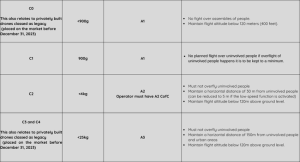
The open category normaly refers to leisure drones and drones that present low risk in drone operations.
Open Category: Low-risk, no pre-approval required.
Here’s a quick reference list of DJI drones already marked in the EU:
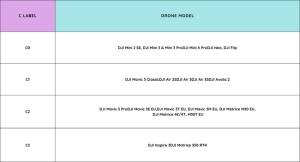
Note: These classifications may be recognised in the UK after 2026 pending CAA final guidance.
From 1st January 2026, the UK Civil Aviation Authority (CAA) will begin enforcing a new drone class marking system aligned with retained EU regulations, introducing mandatory classifications from C0 to C6 for drones operating in the Open Category. This shift presents significant implications for legacy drones such as the DJI Mavic 2 Pro, Phantom 4, and other models released prior to the introduction of C-class identification labels. These unclassified legacy drones will face new operational restrictions—most notably, they will no longer be eligible to operate in subcategory A1 (over uninvolved people) or A2 (close to people) within the Open Category. Instead, they will be confined to subcategory A3 operations, which mandate flying far from people, residential, commercial, industrial, and recreational areas. As a result, operators of these older drones will either need to adapt their operational practices or consider transitioning to newer, C-marked drones if they wish to maintain broader and more flexible flying permissions.
For example if you are adrone pilot still using a Mavic 2 pro, or Phantom 4 for inspections, you will be confined to the A3 subcategory of operations and need to be 150m from uninvolved people, structures etc.
In order to comply with the regulation deadlines, DJI Enterprise has established an easy process to obtain the C2 Class Identification Label for the Mavic 3 Enterprise Series and the Matrice 30 Series current users.
If you own one of the following versions:
Follow the goto the link HERE to register your drone for retrospective classmarking.
Other manufacturers may have a similar scheme in place, to check visit your drone manufacturers website.
The UK’s adoption of drone class marking is a major step towards safer, more efficient, and more trusted drone operations. Operators and manufacturers should prepare now to stay ahead of regulatory changes and take advantage of increased operational freedom.
Resources:
Stay informed, stay compliant, and fly safe.